
Introduction
In the competitive environment of product introduction, engineers frequently experience a "prototype paradox." A perfectly functioning aluminum bracket machined using CNC validation fails in production because of porosity. On the other hand, a design using the flexibility of metal 3D printing results in costs that are multiple times over budget and fatigue life that fails testing. This is because there is a gap between the prototype and production validation. This gap results in wasted performance data, which leads to an average of 40% of the product development budget being wasted.
The reason for this is that there is a limited evaluation approach. In most cases, a prototype is selected based on cost per piece or speed. However, there is no framework that connects the prototype purpose with its objective and cost of ownership. Separating the evaluation of CNC machining, casting, and 3D printing is a recipe for disaster because it guarantees a disconnect between the prototype and its objective. This article will discuss a three-step validation-objective-driven decision framework that can help engineers transform prototyping from a necessary expense to a worthwhile investment.
Step 1: Are You Prototyping for Form, Function, or Process? Defining the “North Star” Validation Objective
The first and foremost question is actually one that many people fail to consider. What is the goal of your prototype, and how will it change if you use it for testing a product's form, function, or process? These three main goals of a prototype correspond to three primary types, each of which will need a separate approach in figuring out the best material, process, and tolerance combination for your project.
Form, Fit, and Assembly Verification: In a situation where you're validating a prototype for physical dimensions, clearances, and how it interacts within an assembly, dimensional accuracy and surface finish are of utmost importance. For this type of prototyping, CNC machining prototyping is usually the reigning champion. This is because, unlike many other prototyping methods, it allows you to start from a solid block of your end-product material, giving you a high degree of confidence in your parts' dimensions.
Functional and Mechanical Performance Testing: When a prototype has to survive real-world conditions, including loading, heat cycles, or flow, its microstructure and bulk properties must be similar to those of the finished production part. The best choice depends on the production process that will be used for mass production. For a part that is to be die cast or sand cast, a metal casting prototyping technique, such as prototyping with 3D-printed sand molds, is a more realistic representation of the grain structure of a cast part than machining a part from a casting. For a part that is to be machined from a wrought part, CNC machining is again the right choice.
Manufacturing Process Feasibility Validation: In some cases, the reason for the prototype is actually to validate the feasibility of the production process in the future. This is often the case with complex and topology-optimized geometries that are destined for series production using additive manufacturing or with complex geometries that are destined for investment casting. In this situation, the prototype is made using the same basic process. In the case of validating the printability of a lattice structure, the only option is using metal 3D printing services. It is essential to understand the different purposes of the process and how resources like this comprehensive guide on "rapid prototyping for metal parts" can help with decision trees and comparisons.
Step 2: Beyond Unit Price: Where Do the True Cost Curves of CNC, Casting, and 3D Printing Intersect?
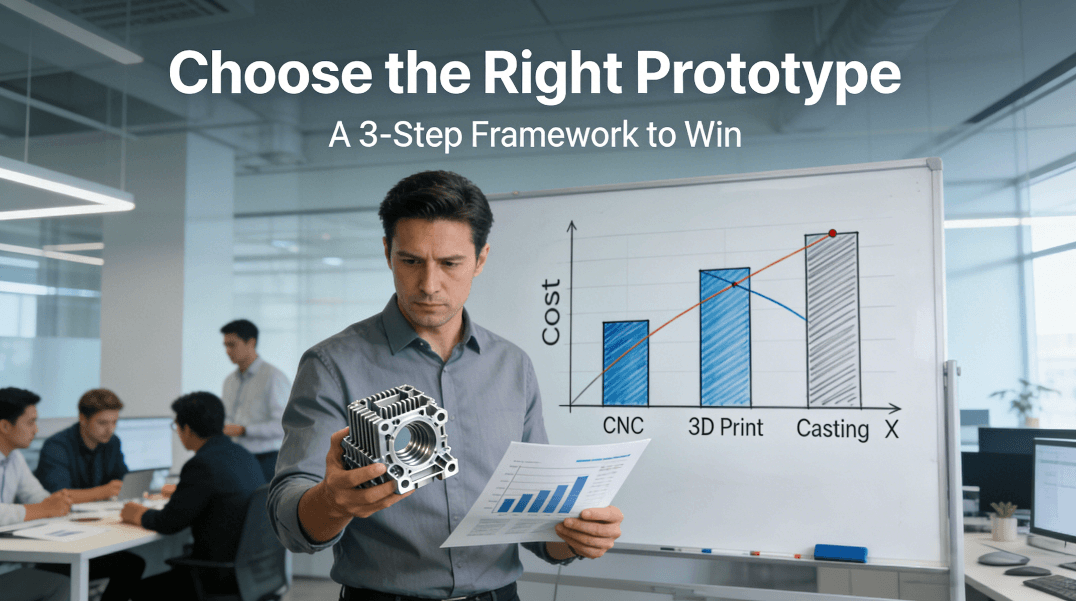
The biggest mistake that can occur in a prototyping project is comparing the unit price of the first article without any context. To understand where we really are economically speaking, we need to look at cost as a function of quantity. Each technology has a characteristic cost curve that is a function of both fixed and variable costs. One of the single most important activities that can help prevent cost overruns is creating a simple graph of quantity versus unit cost. This will help you understand exactly where the cost curves of competing technologies intersect.
1. The Fixed vs. Variable Cost Anatomy
Every technology has a different cost profile. For example, the cost of doing business with a CNC machine has relatively low fixed costs (programming the CAM software, setting up the machine) but high variable costs (machine time, waste generated by the material). Metal 3D printing has high fixed costs (preparing the data, cost allocation of the machine and the powder) but relatively low variable costs for the number of parts that can be produced in a build volume. Rapid casting has high fixed tooling/mold cost but extremely low variable cost per part produced.
2. Mapping the Decision Landscapes
In the case of a moderately complex aluminum component, the cost landscape will normally display well-defined intersections. For 1-2 parts, the prototyping cost analysis suggests that the most cost-effective option would be the CNC machining prototyping option, owing to the low setup cost involved in the process. For a volume of 3-10 parts, the cost analysis suggests that the metal 3D printing option would be a viable alternative since the high fixed cost would be distributed across the number of parts produced in the process. For a volume of more than 15-20 parts, the low cost of metal casting prototyping would make it the most cost-effective option overall.
3. Building a Strategic Prototyping Budget
This framework allows you to develop a strategic phase-based budget instead of a single-line item budget. You may wish to budget for a single CNC-machined part for fit checks, followed by a batch of cast parts for functional checks, etc. This systematic way of managing the cost of prototyping is the foundation of efficient R&D financial management, a concept that has strategic implications in the operational excellence of the manufacturing industry, as strategic analysis by McKinsey & Company suggests.
Step 3: How to Spot a “Solution Partner” Versus a Mere “Service Bureau” in Rapid Prototyping?
The final step is to not only qualify your suppliers based on their capabilities but also on how they can be your solution partner. The distinction between being a "service bureau" and being a "solution partner" is huge. A solution partner is not only able to de-risk your entire project but also has multi-process expertise, co-innovative capabilities, and systemized quality processes.
1. Multi-Process Expertise and Unbiased Guidance
A supplier who only has one technology has an inbuilt bias. A solution partner has multi-process capabilities in CNC machining, metal 3D printing, and casting. They can then offer unbiased guidance based on your North Star objective and cost analysis. They should be able to ask you how you envision producing your end goal and recommend the prototype route that de-risks your future transition, even if it is not necessarily the easiest for them to execute.
2. Engineering Depth and Proactive DFM
The equipment list is only part of the story. What about the conversation between engineers? During quoting, do they offer robust Design for Manufacturability (DFM) feedback specific to that process? More importantly, can they anticipate and alert you to potential problems like designing a part that can only be 3D printed and will never work in a cast part? This is where the real value is built over time, where they essentially become an extension of your own internal R&D team.
3. Quality Systems and Intellectual Property Assurance
For prototypes that are critical to decision-making, there is no compromise when it comes to traceability and robustness. A qualified supplier should offer detailed First Article Inspection Reports (FAIR) and certifications. IATF 16949 and AS9100D are industry certifications that highlight a supplier's commitment to a culture of process control and documentation. Perhaps equally important is a supplier's commitment to protecting your IP. This is where a supplier that stands out in these areas is the final step in a comprehensive rapid prototyping service supplier selection process.
Case Study: From Printed Titanium to Certified Cast Aluminum – A Hybrid Prototyping Journey for an Aerospace Bracket
Theory in action-the ultimate test in practice. An aerospace developer required a lightweight bracket with intricate internal cooling passages to be designed. The problem was twofold – to validate the performance of the intricate internal design, as well as to validate the design for high-integrity investment casting in a series manufacturing process. While only CNC was not possible due to the internal passages, only 3D printing was not possible due to the casting process.
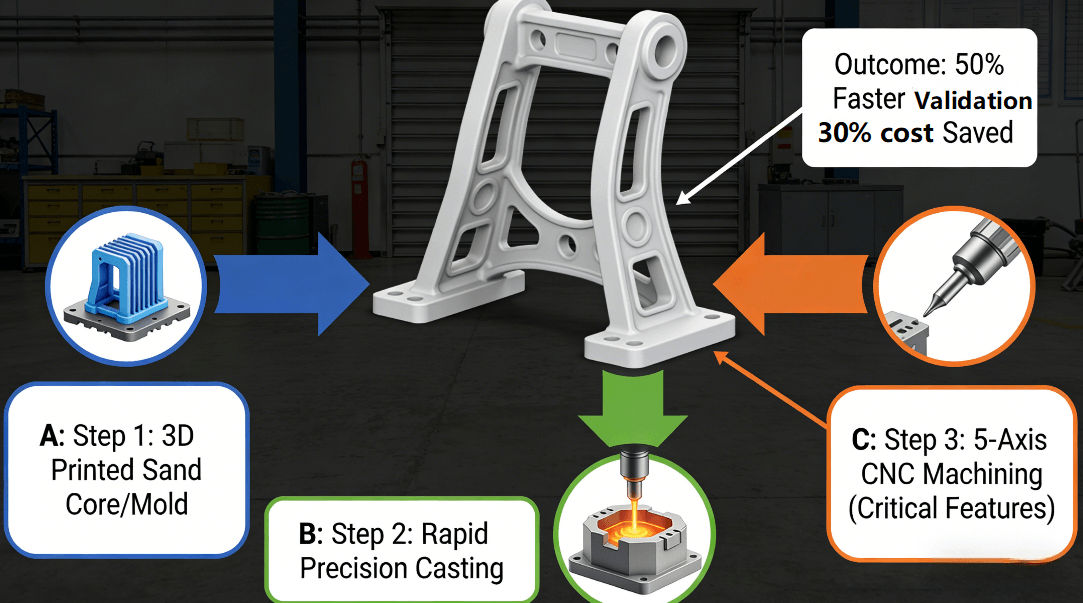
Defining a Hybrid Technical Path: The developer's team proposed an innovative solution by adopting a hybrid prototyping strategy. The team used an innovative solution by adopting three different technologies. The team used high-resolution 3D printing in sand to create an accurate and complex core and mold for the bracket. The team then used a rapid precision casting method to cast an aluminum part. The team then used 5-axis CNC machining for critical mounting interfaces.
Achieving Validation and De-risking Production: This integrated approach, created in partnership with a company, created a prototype that met two master validation requirements. It successfully went through the wind tunnel and thermal tests, validating the functional design of the internal channels. At the same time, it validated the feasibility of the casting process for the complex geometry, offering the company invaluable information in the production tooling design process. This de-risks the entire production launch process.
The Quantifiable Outcome: This process created a 50% reduction in the overall validation process and a 35% cost savings over the traditional sequential prototype development process. This process created a part that is a high-fidelity functional prototype and a high-fidelity process prototype, greatly reducing the overall development process. This is an excellent example of the power of moving past the single-technology solution and embracing the solution-oriented hybrid prototype process.
Conclusion
The best route forward in metal prototyping is not necessarily the best technology, but rather a rigorous process of decision-making based on a clear validation goal, thorough economic analysis, and careful partner selection. By following the three-step process of first understanding their "North Star" validation goal, then understanding the real cost curves, and lastly selecting a real solution partner, the R&D team can turn every dollar spent in the prototyping process into a powerful investment. Not only will this investment yield a physical part, but it will also provide valuable data, de-risk the production process, and speed time-to-market, making the process of prototyping a key driver in product development success.
FAQs
Q: We only require one or two prototypes for the purpose of a fit check. Is CNC always the best choice?
A: If your main goal is simply to have a 1-2 piece fit check, then CNC machining is probably the fastest and most affordable method. This is mainly because of machined solid stock's inherent dimensional accuracy and surface finish. On the other hand, if your design contains elements that a machine couldn't make, not even for a single piece, 3D printing might be your only resort.
Q: How similar are the mechanical properties of 3D printed metal prototypes to cast or machined parts?
A: With the necessary post-processing, mechanical properties of 3D printed metals are roughly on par with castings. Still, the mechanical properties along the print layers might differ from wrought or cast materials. To get accurate testing results with dynamic loading, it is very advisable to have a supplier conversation and ensure that the prototype process reflects the production process.
Q: How much longer does each of the three processes usually take for a regular aluminum part?
A: The difference in lead time depends largely on the complexity of the parts. Here is a rough breakdown:CNC machining is definitely the fastest process among the three.
Q: How do we protect our intellectual property when sharing CAD files with a prototyping supplier?
A: A good prototyping supplier has excellent intellectual property protections in place. Ask for a mutual Non-Disclosure Agreement, and ensure that they offer a secure, encrypted method of transferring files. Prototyping suppliers that service industries that require high intellectual property protections, such as aerospace or medical, likely have excellent intellectual property protections in place.
Q: Can a prototyping supplier help transition the validated design into mass production?
A: A good "bridge to production" supplier absolutely has this capability. They will have gathered valuable information about how their prototyping processes behave, such as distortions, parameters, etc., that will be valuable in creating a production design. Ask potential prototyping suppliers for case studies on their production transition services.
Author Bio
The author is a specialist in advanced manufacturing technologies, with over 15 years of experience in providing integrated multi-process solutions to solve the challenges in product development. The information provided is based on the author's in-depth knowledge in aligning the overall prototype strategy with the success of the final production process. In order to optimize the prototype process for the best efficiency, the first step for any team is to use data analysis. LS Manufacturing is a partner in the ever-evolving world of prototype manufacturing.