
There was a time when every two-way radio conversation had an invisible leash. Walk too far. Drive over the next hill. Lose sight of the other person. Conversation over.
That's how traditional radio communication has worked for decades. If the signal couldn't reach the other radio directly, or through a repeater, you were simply out of luck.
Today, that limitation doesn't define every two-way radio anymore. Modern push-to-talk over cellular (PoC) technology has changed the conversation, allowing compatible radios to communicate far beyond traditional line-of-sight limitations. For travelers, businesses, road crews, RV owners, and families, that opens up entirely new possibilities. So how does it actually work?
First, Let's Talk About Line-of-Sight
Traditional radios rely on radio waves traveling between devices. The fewer obstacles in the way, the better. That's why communication often works beautifully across open fields but becomes less reliable when mountains, forests, buildings, or long distances enter the picture.
It's simply how radio propagation works. No amount of optimism changes physics. For years, users accepted those limits because there wasn't another practical option.
Cellular Changes the Route
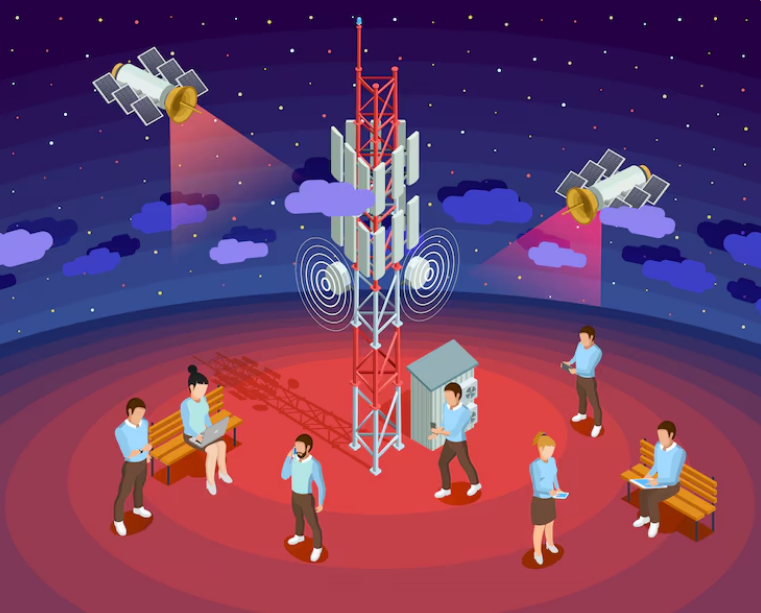
Push-to-talk over cellular takes a different approach. Instead of sending every transmission directly from one radio to another, compatible devices use available cellular data networks to carry voice communication.
Think of it like mailing a package. Instead of trying to throw it directly to someone several states away, which probably won't end well, you hand it to a delivery network that carries it the rest of the way.
The same idea applies here. Your voice is transmitted through the network and delivered to the receiving radio, allowing conversations that extend well beyond the range of traditional line-of-sight communication. That's a major shift in what people expect from a two-way radio.
Distance Stops Being the Main Limitation
Imagine a group traveling across several states. With conventional radios, those vehicles would eventually separate beyond usable range.
With cellular-enabled push-to-talk systems, compatible devices can continue communicating wherever supported network coverage is available.
That's particularly useful for:
RV caravans
Long-distance road trips
Mobile work crews
Property management teams
Event coordinators
Families traveling separately
The goal isn't simply talking farther. It's staying connected without constantly switching to phone calls.
It's Still Push-to-Talk, Just Smarter
One misconception is that cellular radios behave like ordinary smartphones. Not really. The experience remains familiar. Press the button. Speak. Release.
Everyone on the selected talk group hears the message almost immediately. There's no dialing numbers. No waiting for someone to answer. No creating conference calls every time the group needs to coordinate.
That's one reason many organizations continue to prefer push-to-talk communication even as the underlying technology evolves. The simplicity never disappeared. The infrastructure simply improved.
What Happens If You're No Longer in Sight?
Here's where the biggest advantage appears. Picture two hikers. One reaches the parking area while another remains several miles away. Or imagine two contractors working at opposite ends of a city. Or family members traveling in different vehicles hundreds of miles apart.
Traditional line-of-sight radios would struggle, or stop communicating altogether.
Cellular-enabled two-way radios aren't limited by visual distance between users. Instead, communication depends on supported network availability, allowing conversations to continue across much larger geographic areas than conventional handheld radios alone. That's a fundamentally different way of thinking about range.
There Are Still Limits
No technology solves every communication challenge. If supported cellular networks are unavailable in a particular location, push-to-talk over cellular can't function independently of that infrastructure.
Likewise, widespread outages affecting available networks can impact communication. Understanding those limitations is just as important as appreciating the advantages. Technology works best when expectations remain realistic.
Designed for the Way People Move Today
Communication has changed because the way people move has changed. Workforces are increasingly mobile. Families travel farther. Businesses coordinate across multiple locations. Outdoor recreation regularly takes people well beyond traditional radio coverage.
Modern communication systems like those explained on the Rapid Radios "Do Rapid Radios Really Work?" page demonstrate how nationwide push-to-talk technology extends communication beyond conventional line-of-sight limitations by using supported cellular networks. Instead of relying exclusively on direct radio transmission, compatible devices can stay connected across much greater distances while preserving the familiar push-to-talk experience.
It's an evolution that fits the way people communicate today.
The Biggest Upgrade Isn't the Button
The push-to-talk button hasn't changed much. Press. Talk. Release. What has changed is everything happening behind the scenes.
A modern two-way radio over cellular isn't trying to defy the laws of physics. Instead, it uses existing nationwide network infrastructure to carry conversations beyond what traditional handheld radios could achieve on their own.
The result isn't just longer range. It's a different way of thinking about communication altogether, one where staying connected depends less on who you can see and more on where supported network coverage can take the conversation.