
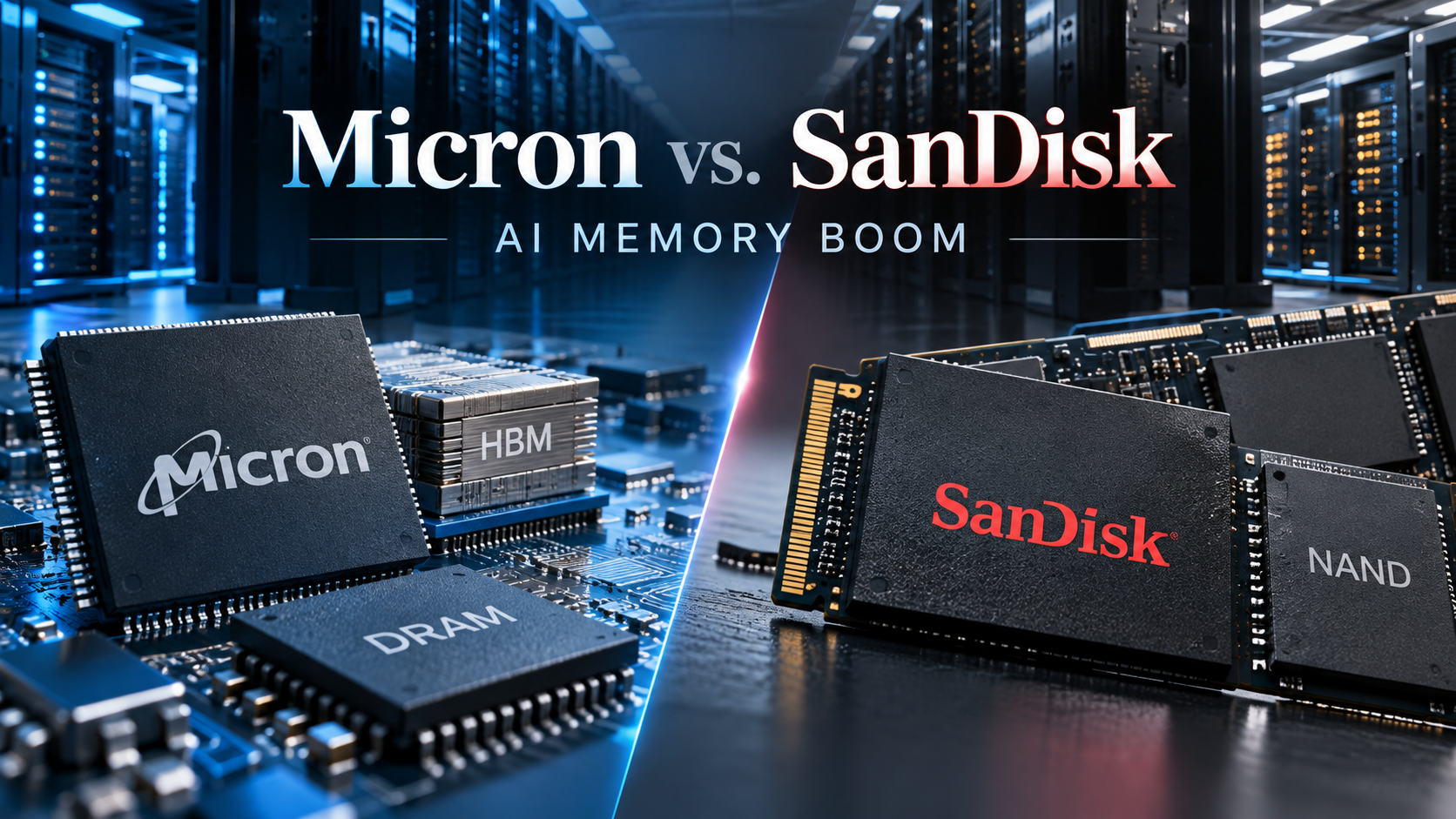
Micron has the more direct link to today's AI memory bottleneck. HBM and server DRAM sit close to AI accelerators, and Micron is already shipping HBM4 in volume. SanDisk offers a different thesis built around enterprise NAND, inference storage and the emerging High Bandwidth Flash, or HBF, architecture.
That does not automatically make Micron the better stock. Returns also depend on memory pricing, margins, execution, capital spending and how much expected growth investors have already priced into each company.
Key Takeaways
Micron sells DRAM, HBM and NAND, giving it exposure to several layers of AI infrastructure.
In fiscal Q3 2026, Micron generated about $31.3 billion from DRAM and $9.9 billion from NAND, roughly 76% and 24% of revenue on a rounded basis.
SanDisk is primarily a NAND and storage company, with enterprise SSDs and data-center flash providing its clearest connection to AI infrastructure.
SanDisk's Datacenter revenue reached about $2.98 billion in fiscal Q4 2026 and $5.15 billion for the full year.
HBF could eventually bring SanDisk closer to AI processors, but it remains in development rather than scaled commercial deployment.
Micron vs. SanDisk at a Glance
Both companies sell NAND, but they participate in different parts of the AI memory hierarchy.
Factor | Micron (MU) | SanDisk (SNDK) |
Core business | DRAM, HBM and NAND | NAND flash and storage |
Main AI-related products | HBM, server DRAM, data-center SSDs | Enterprise SSDs, high-capacity NAND, HBF development |
HBM | Shipping HBM4 | Does not manufacture HBM |
AI training link | HBM, server DRAM and storage | Storage for datasets and other data-center workloads |
AI inference link | HBM, server memory and NAND | Enterprise SSDs, KV-cache use cases and potential HBF |
Latest reported period* | Fiscal Q3 2026 | Fiscal Q4 2026 |
Main sensitivities | DRAM/HBM pricing, capacity and yields | NAND pricing, enterprise demand and HBF execution |
*As of September 24, 2026. Micron is scheduled to report fiscal Q4 results on September 30, so its figures should be updated if this article is published afterward.
Why the AI Memory Boom Is Bigger Than HBM Alone
AI Training Needs Extremely Fast Memory
High Bandwidth Memory stacks DRAM dies close to GPUs and other accelerators, supplying data at much higher bandwidth than conventional memory. Without enough bandwidth, expensive processors can spend time waiting for data.
That makes HBM one of the memory products most directly tied to the expansion of AI compute infrastructure.
AI Inference Is Creating a Storage Problem Too
AI systems also need capacity.
As models move from training to serving large numbers of queries, data centers must store model weights, vector databases, retrieval datasets, generated content and KV caches. These are among the workloads increasing demand for server memory and high-capacity storage.
HBM, conventional DRAM and NAND therefore serve different roles rather than competing as interchangeable technologies.
Micron's AI Advantage: HBM and Server DRAM
HBM Gives Micron Direct Exposure to AI Accelerators
Micron's 36GB 12-high HBM4 entered high-volume production in early 2026 and was designed for Nvidia's Vera Rubin platform. The company says it delivers more than 2.8 TB/s of bandwidth per stack.
By fiscal Q3, Micron said HBM4 was shipping in high volume for its lead customer's platform, with qualification samples sent to additional customers. Management also said cumulative HBM4 shipments had generated more than $1 billion in revenue.
Micron is developing HBM4E using its 1-gamma DRAM process, with volume production expected during calendar 2027. That remains a roadmap target rather than a guaranteed commercial outcome.
AI Also Requires Conventional Server Memory
HBM is only one part of Micron's opportunity.
DRAM produced roughly 76% of fiscal Q3 revenue on a rounded basis, while NAND contributed about 24%. Micron has also shipped qualification samples of 256GB DDR5 server modules using its 1-gamma technology.
AI servers need conventional DRAM for host processors, data preparation and inference serving in addition to HBM beside accelerators. Micron therefore participates in both specialized AI memory and broader data-center memory demand.
For readers comparing different ways to gain price exposure to Micron, MUUSDT futures provide a derivatives-based alternative to owning MU shares directly. Futures exposure does not confer shareholder ownership or rights and carries different risks from holding the underlying stock.
SanDisk's AI Opportunity: NAND Moves Closer to AI Compute
Enterprise Flash Is Becoming More Important for AI
SanDisk's Datacenter revenue increased from about $1.47 billion in fiscal Q3 2026 to roughly $2.98 billion in Q4, a 103% sequential rise. The segment represented around one-third of quarterly revenue.
That does not mean the entire segment is driven by AI. Enterprise SSDs serve many data-center workloads. Model storage, fast data lakes, retrieval systems and persistent KV-cache implementations are among the applications that could increase flash requirements as inference grows.
NAND is not a replacement for HBM. It provides a much larger persistent storage tier lower in the memory hierarchy.
HBF Could Create a New Near-Compute Flash Tier
High Bandwidth Flash is SanDisk's attempt to bring NAND closer to AI processors.
HBF is designed to offer much greater near-compute capacity and far more bandwidth than traditional SSD storage. For suitable inference workloads, its architecture could potentially improve cost per bit or overall system economics. Commercial pricing has not yet established those benefits as a factual outcome.
SanDisk and SK hynix released the first HBF technical specification through the Open Compute Project in August 2026. It includes configurations of up to 512GB and bandwidth targets reaching about 3 TB/s.
Those are specification targets, not results from large-scale deployment. SanDisk said in August that it had taped out its first HBF memory die and was working toward customer samples for HBF-based inference devices in 2027.
HBF should therefore be treated as an emerging opportunity, not an established revenue stream.
Where Micron and SanDisk Differ Most
An HBM-Led Buildout Favors Micron's Product Mix
If AI spending remains focused on accelerators and the memory sitting beside them, Micron has the clearer connection.
HBM demand scales with accelerator deployments, while conventional server DRAM is still required elsewhere in the system. Micron also sells NAND, so its data-center position extends beyond HBM.
A Storage-Heavy Inference Cycle Creates a Different Opportunity for SanDisk
A stronger shift toward inference could increase demand for persistent flash used for models, datasets, retrieval systems and some KV-cache architectures.
SanDisk's August 2026 Investor Day materials, citing TechInsights, estimated enterprise data-center flash demand could reach 1.2 zettabytes by 2030. That is a forecast rather than an observed future outcome.
SanDisk can participate through enterprise SSDs and higher-density NAND before HBF becomes commercially significant. HBF adds another possible growth path if system makers eventually qualify and deploy the technology at scale.
Different Products Mean Different Financial Sensitivities
Micron is more directly tied to DRAM and HBM economics while retaining a meaningful NAND business.
SanDisk is much more concentrated in NAND, making its results particularly sensitive to NAND prices, supply discipline and customer mix. That does not prove its earnings will always move more sharply than Micron's.
Being closer to AI compute also does not guarantee stronger stock performance.
The Stock Question: Financial Expectations Matter Too
A company can benefit from AI demand while its shares disappoint if investors expected even faster growth.
Micron reported record fiscal Q3 revenue of $41.46 billion and guided fiscal Q4 revenue to $50 billion, plus or minus $1 billion, with an expected gross margin of about 86%. Those remain forecasts until its September 30 earnings release.
SanDisk has also set ambitious long-term targets. At its August Investor Day, management projected mid-to-high-teens revenue growth for fiscal 2028 through 2030, non-GAAP gross margins around 80% and adjusted free-cash-flow margins near 50%.
These are management targets, not guaranteed outcomes.
That is why comparing MU and SNDK as stocks requires more than deciding which company has the stronger AI product story. Valuation matters alongside revenue growth, margins and cash generation.
Read more: Is Buying Smallcap Stocks a Wise Long-Term Investment?
The Risks Investors Should Compare
Micron
HBM qualification and manufacturing execution
High capital requirements for advanced memory capacity
Exposure to cyclical DRAM and NAND pricing
Concentration among major AI customers
SanDisk
High sensitivity to NAND supply and pricing
Uncertainty around the pace of enterprise AI storage demand
HBF qualification and commercialization risk
Dependence on flash manufacturing partnerships with Kioxia
SanDisk is also expanding its use of New Business Model, or NBM, agreements. These are multi-year customer contracts that can include committed volumes, pricing mechanisms and financial guarantees. They may improve planning visibility, but they do not remove demand or pricing risks.
Micron or SanDisk: A Better Way to Compare the Two Stocks
Investor Question | More Direct Business Exposure |
Which currently ships HBM? | Micron |
Which has substantial DRAM exposure? | Micron |
Which is primarily concentrated in NAND? | SanDisk |
Which sells memory directly beside AI accelerators? | Micron |
Which is more focused on enterprise flash and persistent storage? | SanDisk |
Which thesis depends more on a new memory architecture? | SanDisk, through HBF |
Micron currently offers the more direct connection to the high-bandwidth memory used in AI accelerator systems. SanDisk represents a more concentrated enterprise-flash thesis, with additional potential if HBF reaches commercial adoption.
Neither distinction predicts which stock will outperform.
What to Watch Next
For Micron, the immediate catalyst is its September 30, 2026 fiscal Q4 report. Key areas include HBM4 shipments, customer qualifications, DRAM and NAND revenue mix, margins and progress toward HBM4E.
For SanDisk, watch Datacenter revenue, enterprise SSD mix, NAND pricing and execution of its NBM agreements.
HBF should be tracked through concrete milestones such as silicon validation, customer samples, system qualification and eventual volume deployment, rather than specification announcements alone.
FAQs
Is SanDisk an HBM manufacturer?
No. SanDisk focuses primarily on NAND flash. HBF uses NAND and should not be confused with DRAM-based HBM produced by companies such as Micron, SK hynix and Samsung.
Why does AI increase demand for NAND flash?
AI data centers require persistent storage for model weights, datasets, vector databases, checkpoints, generated content and some KV-cache workloads. These applications can increase enterprise NAND demand as AI infrastructure expands.
Does Micron make both DRAM and NAND?
Yes. Micron produces HBM, conventional DRAM, NAND and data-center SSDs, giving it exposure to several layers of the memory and storage stack.
What is High Bandwidth Flash?
HBF is an emerging NAND-based architecture designed to place much larger amounts of flash closer to AI processors while offering higher bandwidth than conventional SSD storage. Its first technical specification was released in August 2026, but commercial deployment is still developing.
Does stronger AI demand mean MU or SNDK stock must rise?
No. Stock performance also depends on valuation, memory pricing, execution, competition, capital spending and how much expected growth is already reflected in share prices.